
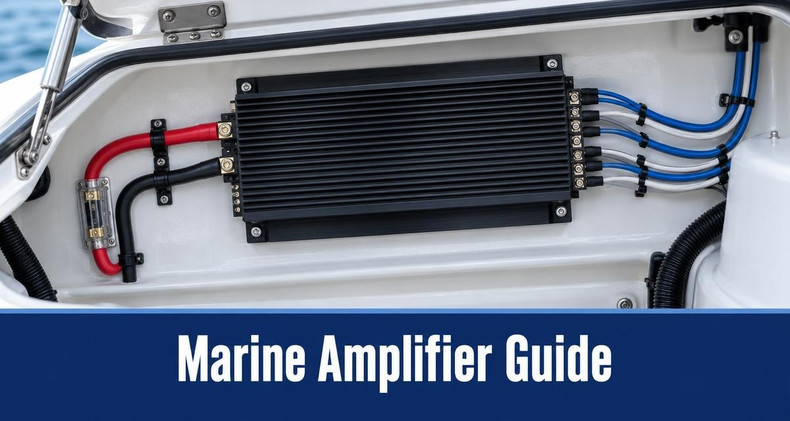
An amplifier gives your speakers and subwoofer the clean power they need to sound good over wind and engine noise. Choosing one comes down to three questions: how many channels, how much power, and what voltage your boat runs on.
Step 1: Count your channels
Each amplifier channel powers one speaker or one group of speakers. Match the channel count to your setup:
Monoblock (1 channel): Built for a subwoofer. Examples include the Fusion Apollo monoblock amplifier (650 watts RMS).
2-channel: Powers one pair of speakers.
4-channel: Powers two pairs of speakers. A popular choice for cockpit and cabin speakers, such as the JL Audio Mx 4-channel amplifier.
5- and 6-channel: Powers four or six speakers, or four speakers plus a subwoofer. The Fusion Apollo 6-channel (1800 watts) is an example.
8-channel: Covers a larger boat with many speakers, like the JL Audio XDM 8-channel.
Step 2: Match the watts to your speakers
Look at the speaker's RMS power rating, which shows what it can handle continuously, and choose an amplifier with a similar output per channel. A little extra headroom is fine, but avoid a big mismatch. A weak amplifier can distort when you turn it up, and an oversized one can damage small speakers if the volume is pushed too far.
Also check impedance, usually 4 ohms for marine speakers. The amplifier must support the impedance you wire up.
Step 3: 12V or 24V?
Most boats run on a 12-volt electrical system, and some larger vessels use 24 volts. Choose an amplifier rated for your system. Some models are offered in both versions, so check the product name and description carefully before you order.
Amplifier features worth knowing
Class D design: Efficient and compact, so it runs cooler and draws less current than older designs.
Built-in DSP (digital signal processing): Some amplifiers include tuning tools and crossovers that can simplify setup.
Zone amplifiers: Smaller amplifiers that power extra zones in a networked system. See the Fusion Apollo zone amplifier for an example.
Marine construction: Look for conformal-coated circuit boards and corrosion-resistant hardware for use in a damp environment.
Wiring basics
Follow the manufacturer's wiring and fusing instructions exactly. The fuse protects your boat's wiring, so install it as the instructions specify.
Use the wire gauge the manual recommends. A lower AWG number means thicker wire, and longer runs or higher current need thicker wire.
Use marine-grade, tinned wire and sealed connectors.
Mount the amplifier where air can circulate and where it will stay dry.
If you are unsure about the electrical work, ask a qualified marine electrician.
Build a system that fits
A typical wake boat might use a stereo, two pairs of tower speakers and a subwoofer, powered by a 4-channel plus a monoblock amplifier, or by one 5-channel amplifier. A small fishing boat may need only a stereo with a built-in amplifier. Browse our full range in the marine amplifiers category, and pair it with speakers and subwoofers and a marine stereo.
Frequently asked questions
Can I run a subwoofer without an amplifier?
Passive subwoofers need an amplifier. Powered subwoofers include one.
Do I need a separate amplifier if my stereo has one built in?
Only if you want more power, more channels or a subwoofer.
Can I bridge channels?
Some amplifiers allow bridging for more power into one speaker. Check the manual for your model.
Not sure what to buy? Email support@coolbranddesigns.com with your speaker models and we will help.